
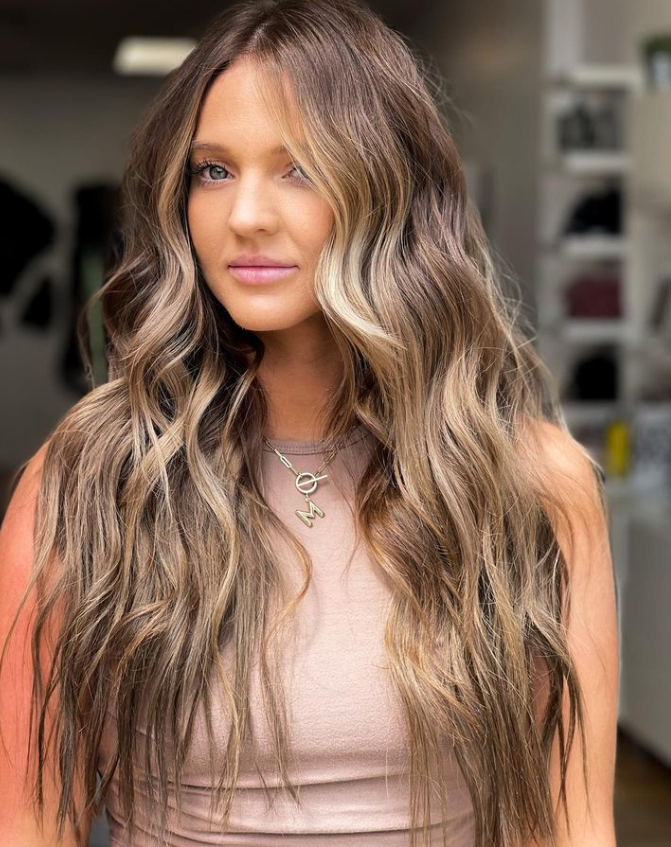
If you’ve started researching hair extensions, you’ve probably run into a wall of unfamiliar terms — hand-tied, K-Tip, tape-in, keratin bond — with no clear answer on which one actually fits your hair and your life. All three are legitimate, widely-used methods; none of them is universally “best.” The right one depends on your hair density, how much maintenance time you actually want to commit to, and what you’re trying to achieve. Here’s a real, detailed breakdown, plus why we build our installs at Authentic Strands using a custom combination of two of them.
Hand-Tied Extensions
Hand-tied wefts are sewn — not glued or taped — onto tiny beaded rows installed close to the scalp. Because each weft is thin and flat, hand-tied extensions tend to lie closer to the head and move more naturally than bulkier machine-made wefts.
Pros:
- Lies flat against the scalp with minimal bulk
- The actual hair can typically be reused across multiple move-up appointments, which is part of why many clients see it as better long-term value
- Great for adding both length and broad, all-over volume
Cons:
- Full installs generally take longer in the chair than tape-in appointments
- Requires a stylist specifically trained in beaded-row application
- Not ideal on its own for filling in very fine, isolated sections — that’s often where K-Tip comes in
Typical maintenance: move-up appointments roughly every 6–10 weeks depending on your natural hair growth and density, though this varies by stylist and hair type.
K-Tip (Keratin-Tipped) Extensions
K-Tip extensions use individual strands with a keratin tip that’s fused to your natural hair using heat, rather than sewn onto a row. Because each strand is placed and bonded individually, K-Tip pieces can be positioned with more precision than a full weft row allows.
Pros:
- Moves very naturally since each strand is bonded individually
- Useful for filling in fine or thin areas a full weft can’t reach as precisely
- Can last several months per install with proper care
Cons:
- The heat-fusing process is a real heat event on your natural hair, and removal also requires heat to melt the bond
- Concentrated bond points mean tension is focused on individual strands, which is why proper technique and spacing matter
- Not typically reusable in the same way as hand-tied wefts
Typical maintenance: several months per install before a move-up is needed, though this varies with hair growth and how the bonds hold up.
Tape-In Extensions
Tape-in extensions sandwich a thin section of your natural hair between two adhesive wefts.
Pros:
- Faster installation than hand-tied or K-Tip — often a couple of hours or less
- Lightweight, which can be a good fit for finer or thinner natural hair
- Generally a lower cost entry point than hand-tied or K-Tip
Cons:
- The adhesive bond needs to be redone more frequently than hand-tied or K-Tip — typically every 4–8 weeks
- Oil-based products near the tape can loosen the bond faster
- Not always the best fit for clients who want to wear their hair up often, since the tabs can be more visible
Typical maintenance: re-taped roughly every 4–8 weeks.
How the Three Compare at a Glance
| Method | Attachment | Typical Move-Up Interval | Best For |
|---|---|---|---|
| Hand-Tied | Sewn onto beaded rows | ~6–10 weeks | All-over volume and length with minimal bulk |
| K-Tip | Heat-fused keratin bond, strand by strand | Several months per install | Precise fill-in and natural strand movement |
| Tape-In | Adhesive sandwiching natural hair | ~4–8 weeks | Faster installs, lighter initial investment |
These are general industry ranges, not a quote for any specific salon — your actual schedule depends on your natural hair growth rate and the stylist’s technique.
Why We Combine Hand-Tied + K-Tip
At Authentic Strands, we don’t limit an install to a single method. Every set we build combines hand-tied wefts with K-Tip pieces, customized to your hair density, goals, and the areas that need the most (or least) support. That might mean hand-tied rows for overall volume with K-Tip pieces blended in around the hairline, or a different ratio entirely depending on your natural hair. Whichever combination is right for you gets mapped out at your consultation — not guessed at online. If your set includes extensions, plan on a bump appointment every 6–8 weeks (our confirmed real interval) to keep things comfortable and looking their best.
Frequently Asked Questions
Which method is best for fine or thin hair? Hand-tied wefts are often favored for fine hair because they distribute weight across a flat row rather than concentrating it at individual bond points, though a skilled stylist can also place K-Tip strands sparingly to fill in without adding noticeable weight.
Can I combine more than one method? Yes — this is exactly what we do by default rather than as a special request. Combining methods lets your stylist put the right technique in the right place instead of forcing your whole head into one method.
Do extensions damage your natural hair? Any extension method carries some degree of tension or heat exposure. The risk is generally minimized with correct technique, proper spacing, sticking to your recommended move-up schedule, and following your stylist’s aftercare guidance.
How long will my extensions actually last? The hair itself (for hand-tied and K-Tip especially) can often be reused across multiple move-up cycles with good care — ask your stylist how many cycles to expect for your specific set.
Ready to Find Your Method?
Curious what a custom hand-tied + K-Tip set would look like on you? Take a look at our Hand-Tied + K-Tip Extensions page for the full breakdown of what’s included, or book a consultation directly to get started.
Follow along for real transformations: @authentic.strands on Instagram, or follow founder Nonia at @nonia.antidote.